
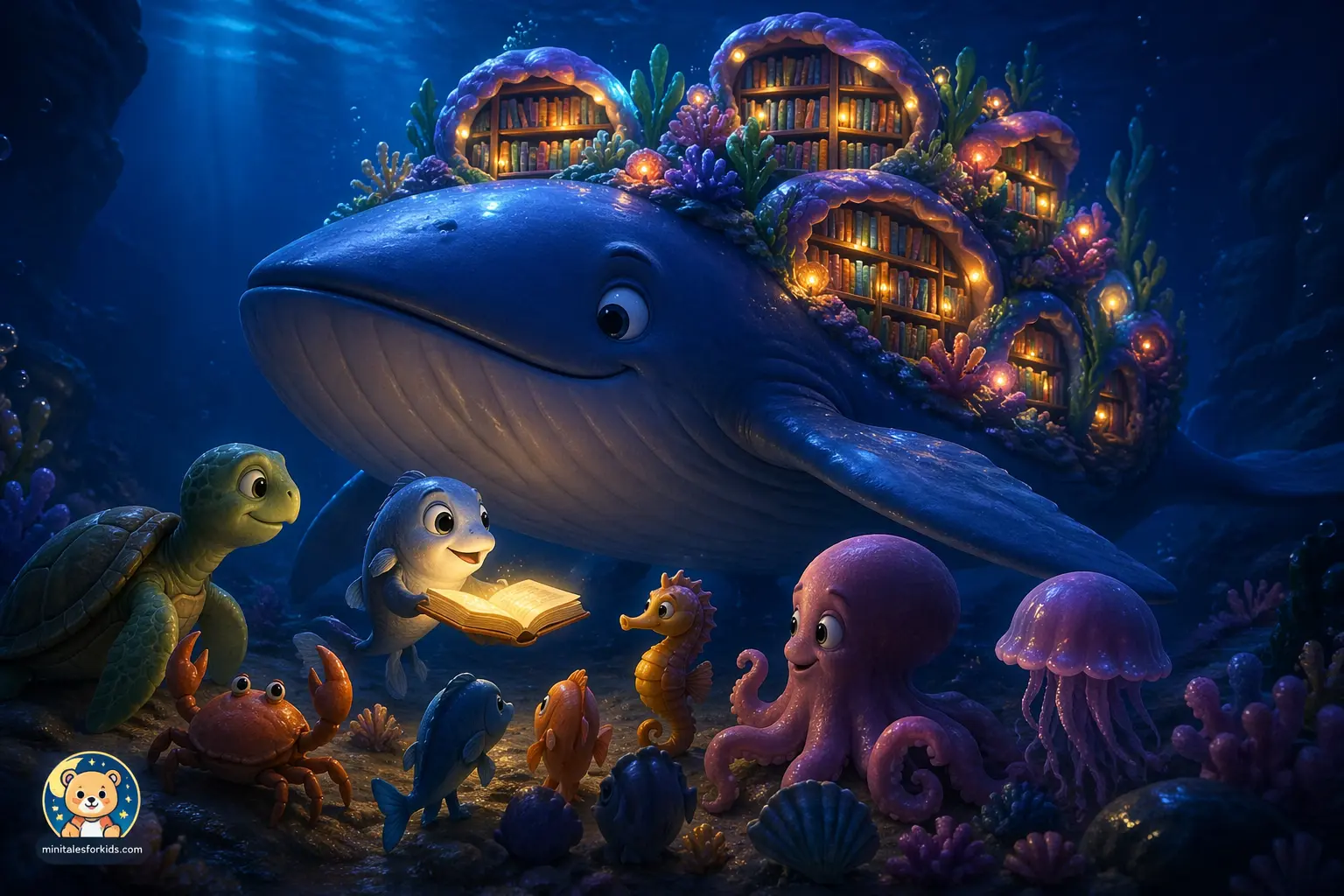
Far beyond the busy harbors and noisy ships, in the deep blue heart of the ocean, there lived a very unusual whale. Her name was Luma, and she was not just any whale—she carried a library on her back.
Not a library made of wood or stone, but one made of glowing shells, whispering corals, and floating pages that shimmered like moonlight. Every story ever told by the sea lived there—stories of brave fish, clever turtles, lost ships, and hidden treasures.
Luma loved stories more than anything. But there was a problem.
No one visited her library.
The sea creatures were always too busy. The fish swam in schools, the crabs scuttled along the sand, and the octopuses preferred puzzles to stories. Luma would swim slowly through the ocean, hoping someone would notice the gentle glow on her back.
“Would you like a story?” she would ask softly.
But most creatures just hurried by.
One quiet evening, as the water turned purple with sunset, Luma heard a tiny voice.
“Excuse me… what is a story?”
Luma turned carefully. A small silver fish hovered nearby, blinking with curiosity.
“A story,” Luma said gently, “is a journey you can take without moving.”
The little fish tilted its head. “Can you show me?”
Luma smiled. One of the glowing shells opened, and from it floated a page that sparkled like stars.
“This is a story about a fish who was afraid of the dark,” Luma said.
The small fish listened closely. As Luma spoke, the water around them shimmered, and the fish could almost see the story happening—how the frightened fish learned that the dark ocean was full of glowing wonders and hidden beauty.
When the story ended, the little fish’s eyes were wide with amazement.
“That was… incredible,” it whispered. “Can I hear another?”
And so Luma told another story. And another.
Soon, the little fish told its friends. And those friends told others.
Within days, creatures from all over the ocean came to visit Luma. Curious seahorses, shy jellyfish, wise old turtles, and even a grumpy crab who pretended not to care—but stayed until the very last story.
The library on Luma’s back grew brighter with each listener. The stories became stronger, richer, and more magical.
One day, the little silver fish asked, “Luma, where do all these stories come from?”
Luma paused for a moment. “Some are old,” she said, “passed down through the waves. But the best ones…” She smiled. “The best ones come from you.”
“From me?” the fish asked, surprised.
“Yes,” Luma said. “Every adventure you have, every fear you face, every kindness you show—that is a story waiting to be told.”
The little fish thought about this. The next day, it returned with a story of its own—about the time it got lost in a sea cave and found its way home by following a trail of glowing plankton.
Luma listened carefully. And as she did, a new shell appeared on her back, glowing with a soft, silvery light.
The fish gasped. “Did I make that?”
Luma nodded. “You did.”
From that day on, the ocean was never the same. The creatures didn’t just listen to stories—they lived them, shared them, and created new ones.
And Luma, the whale who carried a library, was never lonely again.
Because she had discovered something important:
Stories are not just something we read or hear.
They are something we become.
And every small voice—no matter how quiet—has a story worth telling.